
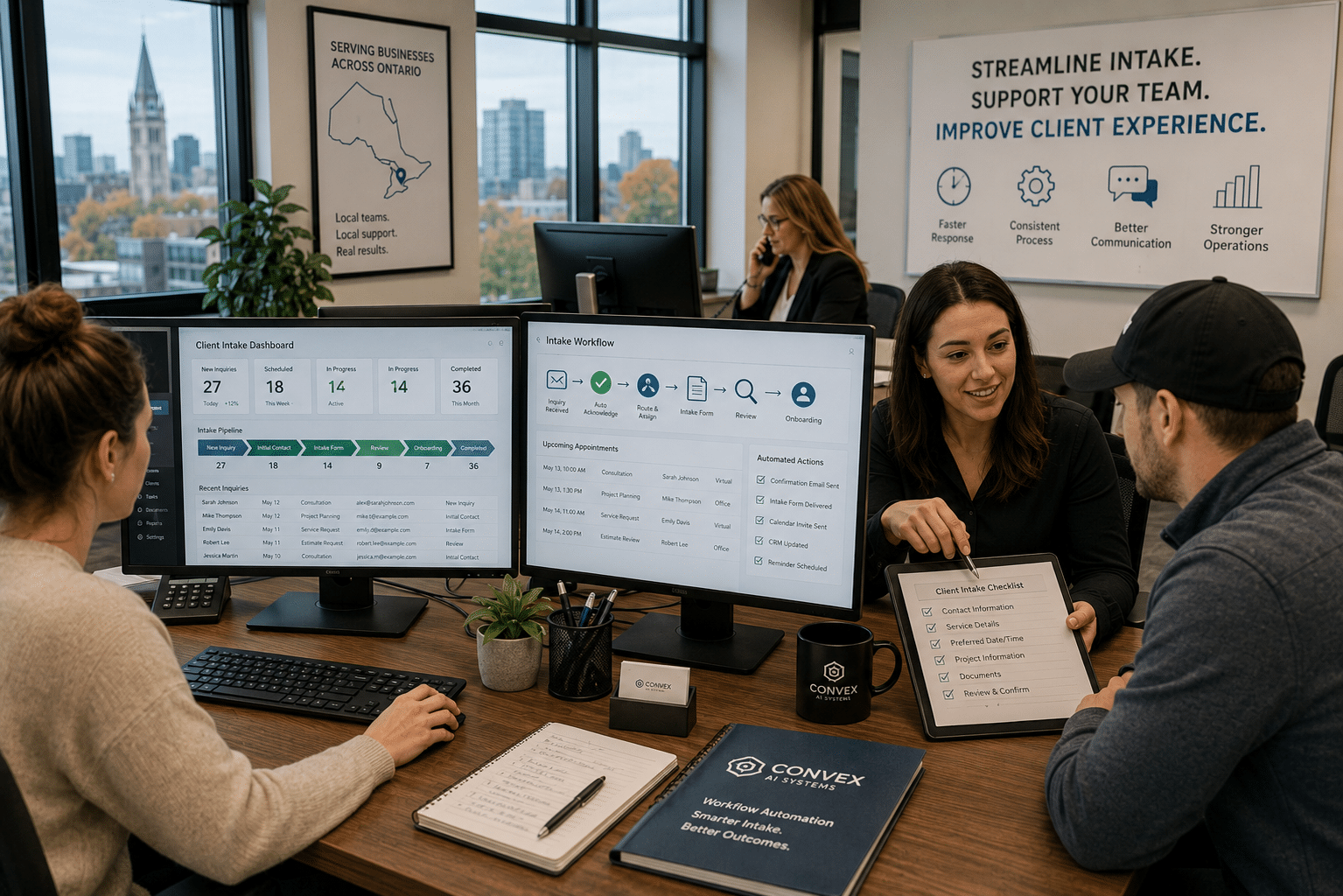
As service businesses grow, client intake often becomes one of the first operational systems to break down under increasing demand. More inquiries, appointment requests, onboarding steps, and follow-up communication create pressure on administrative teams that are already balancing scheduling, customer coordination, and reporting responsibilities.
The problem is not usually a lack of effort from staff. In many Ontario SMBs, intake processes become fragmented because workflows evolve faster than operational systems. Teams rely on email chains, spreadsheets, manual reminders, and disconnected software platforms to manage increasing client activity.
This is where structured client intake workflows become important. Client intake automation is not about replacing customer-facing employees. It is about improving operational consistency, reducing repetitive coordination work, and helping staff manage growing demand more effectively.
Why Client Intake Becomes a Bottleneck as Service Businesses Grow
Most service businesses begin with relatively simple intake processes. A customer submits an inquiry, someone responds manually, scheduling is coordinated, and onboarding information is collected as needed.
As inquiry volume increases, however, those same workflows become more difficult to manage consistently.
Administrative teams often start tracking inquiries across multiple systems. Some requests arrive through email, others through forms, phone calls, social media messages, or CRM platforms. Follow-ups become harder to monitor, documentation becomes inconsistent, and response times begin varying between employees.
In many cases, businesses compensate by adding more administrative coordination instead of restructuring the workflow itself.
This is why operational reviews often begin with an AI readiness audit. Before implementing automation, businesses need visibility into how intake workflows currently operate, where communication delays occur, and which repetitive tasks create the most operational friction.
Without that operational analysis, automation risks adding complexity to already unstable workflows.
What Client Intake Automation Actually Means
Client intake automation is frequently misunderstood as replacing human interaction with software systems. In practice, effective intake automation supports employees by reducing repetitive coordination work while preserving customer-facing communication.
For example, intake automation may include:
- inquiry routing
- scheduling coordination
- automated confirmations
- intake form processing
- CRM updates
- document collection reminders
- workflow tracking
These improvements help businesses standardize recurring operational steps without removing employees from customer relationships.
Structured AI workflow automation focuses on operational reliability rather than aggressive automation. The objective is to reduce workflow fragmentation so staff can focus on customer support, service delivery, and exception handling instead of repetitive administrative coordination.
For example, a service business may automate appointment confirmations and intake tracking while still relying on employees for consultations, onboarding conversations, and customer issue resolution.
The operational benefit is consistency, not replacement.
The Most Common Intake Problems Ontario SMBs Face
Many Ontario service businesses experience similar intake workflow problems as they scale.
Delayed responses are one of the most common issues. When inquiries arrive through multiple channels without centralized tracking, teams struggle to maintain consistent response times.
Communication fragmentation also creates operational risk. Businesses often discover during reviews of the communication workflow that intake updates are scattered across emails, messaging platforms, spreadsheets, and undocumented employee processes.
Duplicate data entry is another recurring problem. Administrative staff frequently re-enter the same customer information into scheduling systems, CRMs, invoices, and reporting tools because platforms are not properly connected.
Documentation inconsistency also creates operational strain. Reviews of the documentation workflow commonly identify missing records, incomplete onboarding information, and inconsistent intake standards between employees.
Other common operational problems include:
- missed inquiries
- inconsistent onboarding
- delayed scheduling
- fragmented customer updates
- intake ownership confusion
- lost documentation
- disconnected follow-up tracking
These operational gaps usually expand as businesses grow unless workflows become more structured.
Which Parts of Intake Workflows Are Best Suited for Automation
Not every part of client intake should be automated. Human communication remains important for relationship management, service consultations, and exception handling.
However, repetitive coordination tasks are often well suited for automation support.
Appointment requests are one example. Instead of relying on manual scheduling coordination across multiple emails, businesses can standardize intake routing and confirmation workflows.
Lead routing is another common automation opportunity. Incoming inquiries can be organized based on service type, location, urgency, or department ownership before staff begin active communication.
Document collection also benefits from operational automation. Businesses can standardize reminders, intake sequencing, and record collection without requiring employees to manually monitor every onboarding stage.
CRM synchronization is another important operational improvement. Systems such as CRM OpenAI integration workflows can help reduce duplicate administrative work between customer communication systems and operational databases.
Operational connectivity matters as well. Structured API automation setup helps businesses improve consistency between intake platforms, scheduling systems, documentation workflows, and reporting tools.
The objective is not to fully automate customer relationships. It is to reduce repetitive administrative coordination surrounding those relationships.
Why Poor Intake Processes Create Larger Operational Problems
Client intake workflows affect far more than initial customer communication.
When intake systems become inconsistent, reporting visibility often declines because information is incomplete or fragmented across platforms. Scheduling conflicts increase because updates are not synchronized between departments. Sales and onboarding teams may also struggle with delayed follow-ups when intake ownership is unclear.
A fragmented sales follow-up workflow can create operational gaps between inquiry handling and customer conversion activities.
Poor intake coordination also affects customer experience directly. Delayed responses, repeated information requests, and inconsistent onboarding communication can reduce operational credibility even when service quality remains strong.
These issues are particularly common in service-heavy industries such as real estate and property operations, HR and recruitment, and construction and trades, where intake coordination, scheduling, and documentation management often scale simultaneously.
What Businesses Should Evaluate Before Automating Intake
Before implementing intake automation, businesses should evaluate operational readiness carefully.
First, workflows should be reasonably clear and repeatable. If intake procedures vary significantly between employees, automation may increase confusion rather than improve consistency.
Second, businesses should review software overlap and operational dependencies. Many intake inefficiencies are caused by disconnected systems rather than workload volume alone.
Third, intake ownership should be clearly defined. Teams need visibility into who manages responses, approvals, scheduling coordination, and documentation standards throughout the intake process.
Operational consistency also matters. Businesses should establish realistic response expectations, documentation standards, and workflow accountability before expanding automation across systems.
Structured AI system design and integration helps businesses align automation planning with operational requirements instead of layering disconnected tools onto unstable workflows.
For businesses seeking local operational support, structured workflow consulting services are also available through the Cambridge operations location.
Long-term workflow stability should also be considered before deployment. Businesses need processes for maintaining intake systems as operational requirements evolve over time. Without governance and ownership, even well-designed intake workflows can gradually become fragmented again.
How Structured Intake Workflows Support Long-Term Operational Growth
Well-structured intake workflows help businesses improve operational consistency as inquiry volume increases.
Standardized intake systems improve visibility into workflow performance, reduce communication fragmentation, support more consistent documentation, and create clearer operational ownership between departments.
This operational structure also improves scalability. Businesses can expand services, onboard new employees, and manage increasing customer activity more reliably when workflows follow consistent operational standards.
Staff also benefit from clearer operational systems. Instead of manually tracking every inquiry, approval step, and onboarding update across disconnected tools, employees can focus more attention on customer communication and service delivery.
Leadership benefits as well through improved reporting visibility and more reliable operational tracking. Consistent intake systems make it easier to identify bottlenecks, monitor response timelines, and improve coordination across departments.
Sustainable workflow automation depends on structure, governance, and operational clarity rather than rapid deployment alone.
Book a workflow assessment to identify intake bottlenecks and automation opportunities within your current operational process.