
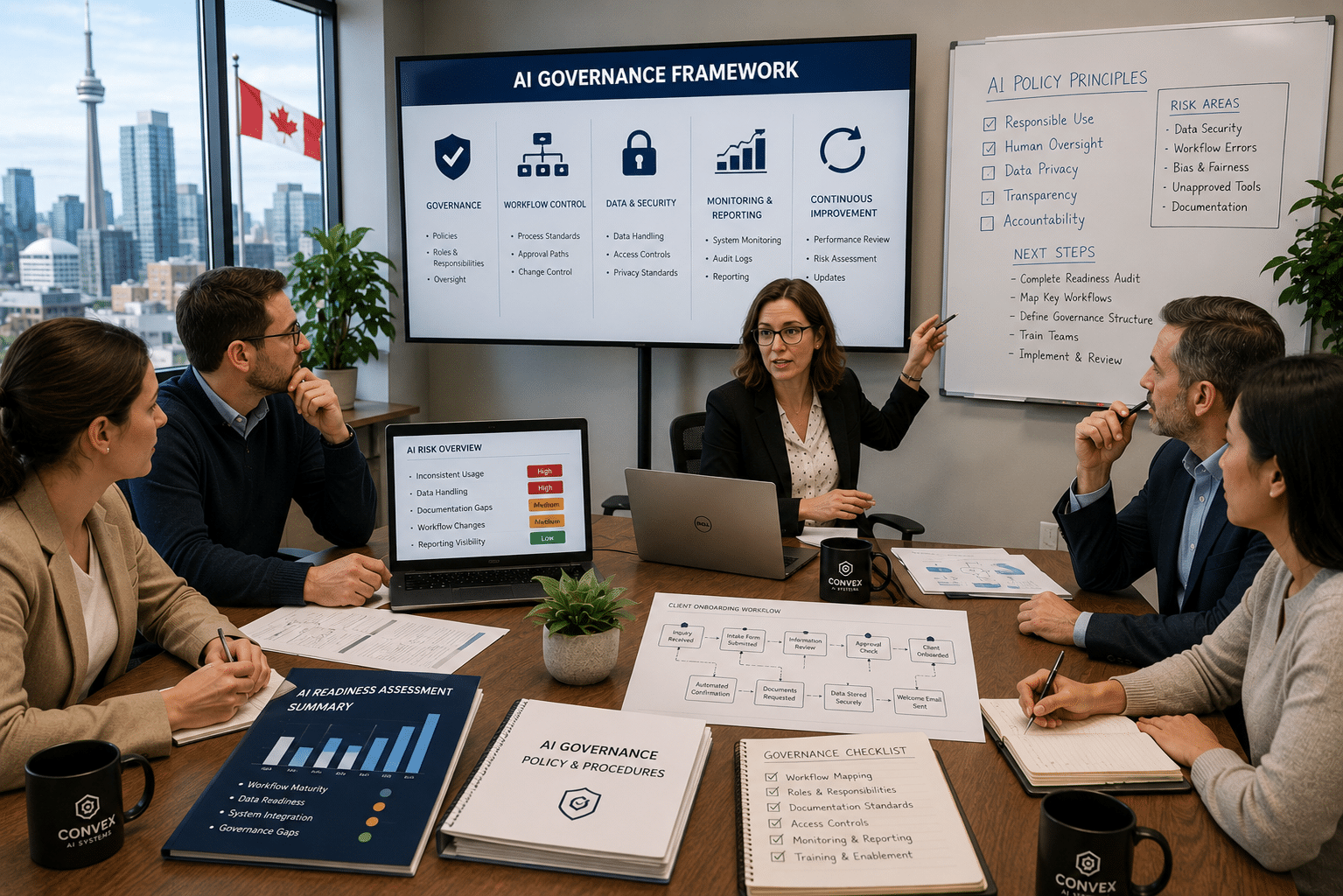
Many Canadian businesses are implementing AI tools faster than their operational systems are prepared to support them. Teams begin using AI for reporting, communication, workflow automation, onboarding, and internal coordination before governance standards are clearly established.
The problem is not AI adoption itself. The issue is that operational controls often develop after implementation rather than before it.
For SMBs, this creates workflow inconsistency, unclear accountability, fragmented documentation, and operational risk that becomes more difficult to manage as automation expands.
This is why structured AI consulting increasingly focuses on governance and operational reliability rather than software deployment alone. Responsible AI implementation starts with workflow structure, documentation standards, and operational oversight before automation scales across departments.
Why Businesses Are Implementing AI Faster Than Their Operational Controls
Many businesses adopt AI tools incrementally. One department introduces automated reporting. Another begins using AI-assisted communication tools. Administrative teams implement workflow automation to reduce repetitive coordination work.
Over time, these disconnected implementations create operational inconsistency.
Employees may follow different usage standards across departments. Documentation procedures become fragmented. Workflow approvals vary between teams. Reporting visibility declines because processes evolve faster than governance structures.
This is particularly common in SMB environments where operational systems are already stretched by growth demands.
Businesses often assume governance becomes necessary only after AI systems become more advanced. In reality, governance matters most during early implementation stages when workflows are still being defined.
This is why many organizations begin with an AI readiness audit before expanding automation further. The objective is to identify governance gaps, operational dependencies, workflow risks, and documentation inconsistencies before those issues scale across systems.
Without that operational review, businesses risk building automation on top of unstable processes.
What AI Governance Actually Means for SMB Operations
AI governance is frequently misunderstood as a legal or enterprise-only concern. For SMBs, governance is primarily operational.
It defines how workflows are managed, how systems are monitored, who approves automation changes, and how operational consistency is maintained over time.
Effective governance usually includes:
- workflow accountability
- approval structures
- documentation standards
- employee usage expectations
- reporting oversight
- maintenance procedures
- operational monitoring
This is why structured governance and maintenance becomes an important part of long-term AI implementation.
Without governance, businesses often lose visibility into how workflows operate across departments. Employees create inconsistent processes, automation expands without operational review, and documentation standards decline as systems become more complex.
Governance is not about creating bureaucracy. It is about maintaining operational reliability as automation increases.
For SMBs, governance also helps reduce operational dependency on informal processes. Instead of relying on individual employee habits or undocumented workflow decisions, businesses establish repeatable operational standards that improve consistency across teams.
The Operational Risks Businesses Commonly Overlook
Most operational AI risks inside SMBs are caused by inconsistent workflows rather than technical system failures.
One common issue is inconsistent employee usage. Different staff members may use AI tools differently depending on department practices, undocumented habits, or informal workflows.
Documentation gaps are another recurring operational problem. Reviews of the documentation workflow often reveal inconsistent recordkeeping, missing process visibility, and unclear operational standards surrounding automated workflows.
Communication inconsistency also creates operational risk. A fragmented communication workflow may lead to conflicting responses, approval confusion, or incomplete tracking of operational decisions.
Other commonly overlooked risks include:
- unauthorized automation changes
- fragmented reporting structures
- unclear workflow ownership
- inconsistent escalation paths
- undocumented approval processes
- disconnected operational systems
- uncontrolled client data handling
These are governance failures at the workflow level. They usually emerge gradually as businesses implement automation without consistent operational oversight.
Another common issue is workflow sprawl. Departments independently adopt AI tools that solve immediate operational problems without considering broader workflow alignment across the business. Over time, this creates disconnected systems that are difficult to monitor and maintain consistently.
Why Governance Matters Before Workflow Automation Expands
Workflow automation increases operational efficiency only when systems remain stable and accountable over time.
Without governance, businesses often experience process inconsistency as automation expands. Different teams create separate operational rules, reporting structures diverge, and maintenance responsibilities become unclear.
This creates operational instability rather than improvement.
Structured AI workflow automation depends on governance because automated systems require consistent workflows, documented processes, and clear operational ownership.
For example, businesses using synchronization systems such as workflow sync maintenance still need oversight procedures to ensure workflows remain aligned as systems evolve.
Governance also becomes increasingly important in documentation-heavy operational environments such as legal and compliance, HR and recruitment, and accounting and bookkeeping, where process consistency and operational traceability are especially important.
The more workflows depend on automation, the more operational discipline becomes necessary.
Well-governed systems also improve long-term maintainability. Businesses can update workflows, onboard new employees, and scale operational systems more reliably when governance standards already exist.
What Responsible AI Usage Looks Like Inside an SMB
Responsible AI implementation inside SMBs usually looks far less complicated than many businesses expect.
In practice, it often means creating clear operational standards around workflow ownership, employee responsibilities, documentation expectations, and approval procedures.
For example, businesses may establish:
- defined workflow permissions
- escalation paths for exceptions
- operational review procedures
- documentation standards
- reporting oversight responsibilities
- approval structures for automation updates
Operational consistency matters more than complexity.
A business using collaborative AI systems such as ChatGPT team integration may establish internal usage expectations around documentation handling, communication standards, workflow approvals, and employee accountability.
The objective is not to restrict productivity. It is to ensure workflows remain structured, traceable, and operationally reliable as AI usage expands.
Responsible usage also includes knowing where automation should stop. Businesses still need human oversight for sensitive communication, exception handling, operational approvals, and workflow decisions that require judgment.
The Role of Employee Training and Workflow Standards
Governance includes people as much as software systems.
Without employee alignment, even well-designed workflows become inconsistent over time. Teams need shared operational expectations surrounding AI usage, workflow approvals, documentation handling, and communication procedures.
Structured AI team enablement helps businesses create operational consistency by establishing practical workflow standards rather than relying on informal usage habits.
This may include:
- approved workflow procedures
- documentation requirements
- communication expectations
- escalation protocols
- reporting responsibilities
- operational accountability standards
Training also helps reduce workflow fragmentation between departments. Employees understand how automation fits within operational systems instead of creating disconnected processes independently.
Governance succeeds when operational expectations remain practical, visible, and consistently maintained across teams.
How Businesses Can Build Governance Into AI Systems From the Start
The most effective governance strategies begin before automation expands across operations.
Businesses should first evaluate workflow structure, process ownership, documentation consistency, and operational dependencies before introducing large-scale automation initiatives.
Structured AI system design and integration helps businesses align automation planning with governance requirements from the beginning rather than retrofitting operational controls later.
This usually includes:
- workflow mapping
- operational reviews
- approval structure planning
- maintenance procedures
- reporting alignment
- phased implementation sequencing
Phased implementation is particularly important because governance structures often evolve alongside operational maturity. Businesses gain visibility into workflow performance while refining accountability standards gradually instead of attempting large-scale operational changes all at once.
Operational reviews should also continue after deployment. Governance is not a one-time setup process. As workflows evolve, businesses need periodic review processes to maintain operational consistency and identify emerging gaps before they create larger workflow instability.
Businesses evaluating implementation strategies can also review additional operational guidance through the FAQ section, which addresses common workflow automation and governance considerations.
Responsible AI implementation is ultimately about operational structure. Businesses that establish governance early are usually better positioned to scale automation sustainably while maintaining workflow consistency, documentation visibility, and operational accountability.
Book an AI readiness assessment to identify workflow risks, governance gaps, and operational safeguards before deploying AI systems.