
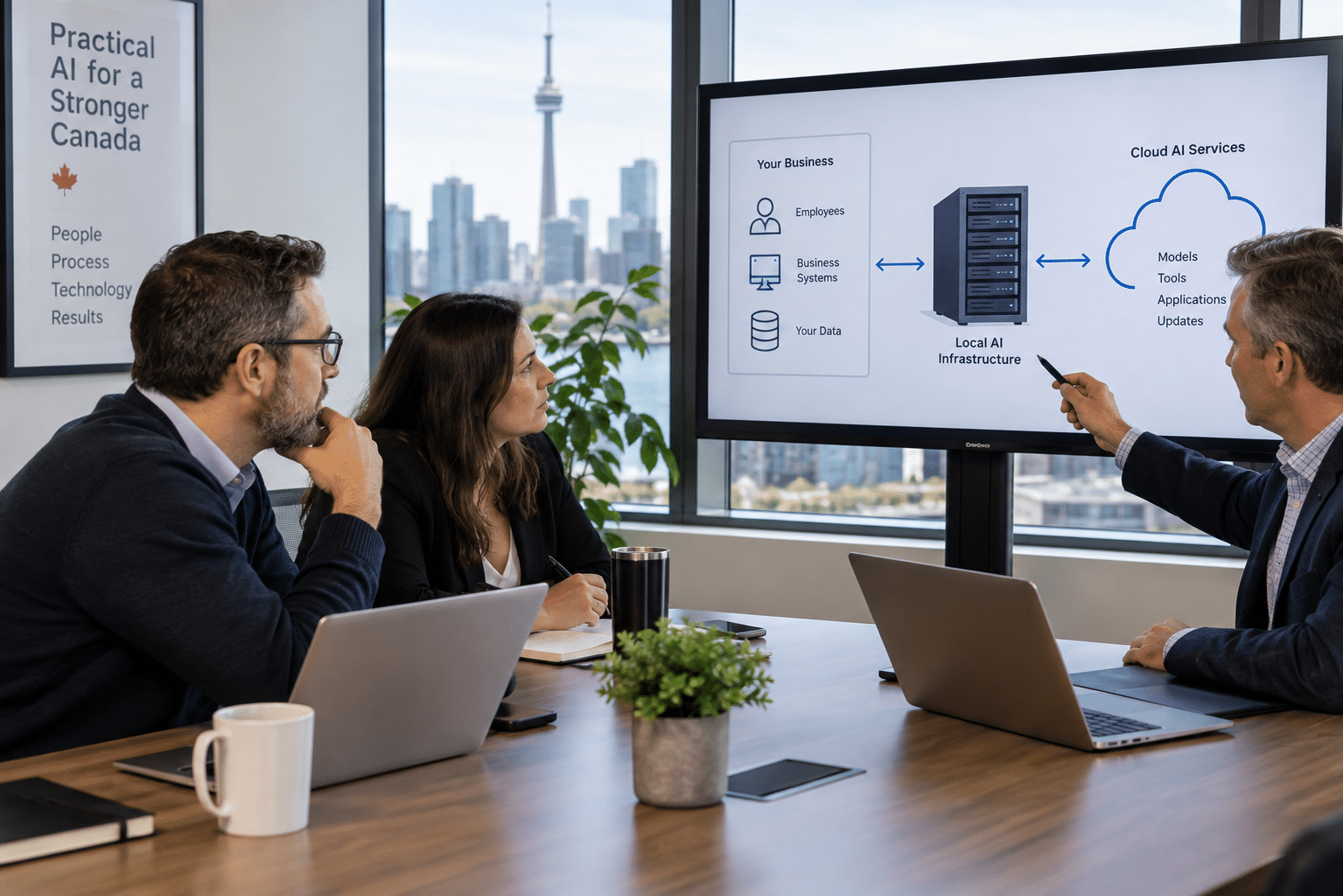
AI is becoming more than a software purchasing decision. As businesses rely on AI for meaningful processes, they also need to consider where that capability operates and how much of it they should control directly.
Until recently, using advanced AI generally meant accessing models and computing resources provided by someone else. Increasingly capable models can now run on infrastructure controlled by the business, creating another legitimate option alongside cloud services.
The question is no longer simply, “Which AI service should we use?” It can also be, “Which AI capabilities, if any, would we benefit from controlling ourselves?”
What Does Local AI Actually Mean for a Business?
Local AI means that a business controls computing infrastructure capable of running selected AI models rather than sending every request to an external provider. Depending on the workload, that infrastructure could range from a capable workstation to more substantial dedicated systems.
Owning local AI infrastructure does not mean replacing every cloud AI service. A business can run selected local AI models while continuing to use external services where they provide greater capability, flexibility, or convenience.
Infrastructure decisions should therefore follow actual business requirements rather than enthusiasm for a particular technology. An AI strategy consulting process can help connect infrastructure choices to operational needs, risks, and priorities.
Why Would a Business Want to Own AI Capability?
The strongest reasons for considering local AI for business usually involve control. A company may want greater control over how certain information is handled, where particular workloads operate, which models are used, or how an important capability remains available.
Local infrastructure may also deserve consideration when workloads are substantial and predictable, when internally contained operation is valuable, or when reducing dependence on any individual provider has strategic value.
However, greater control is not automatically worth the cost and responsibility of ownership. An AI readiness audit can help determine whether an organization has sufficiently defined use cases, processes, information requirements, and internal capabilities to justify infrastructure investment.
The central question remains practical: does greater control create enough business value to justify ownership?
Local AI Does Not Eliminate Dependency
Running a model locally changes where dependencies exist, but it does not eliminate them. The organization may still depend on hardware vendors, model licences, software frameworks, drivers, security maintenance, compatible applications, internal expertise, and replacement equipment.
Downloading or retaining a model therefore does not create permanent independence. A model that operates effectively today may require compatible software, maintained infrastructure, documentation, and knowledgeable employees to remain useful over time.
Local AI changes the dependency structure. It can give a business more direct control over selected components, but that control comes with operational responsibility.
What Happens When Models, Access, or Commercial Terms Change?
Technology systems change throughout their useful lives, and AI infrastructure is no exception. Businesses do not need to predict specific changes, but they should consider how their systems would respond to them.
What happens if a preferred model is discontinued or stops receiving updates? What happens if a cloud service changes its pricing or usage limits? What if licensing terms change, or a replacement model behaves differently enough to affect existing processes?
These are normal technology lifecycle questions rather than reasons to avoid cloud or local AI. A business system should account for change before change becomes urgent.
The more important AI becomes to operations, the more valuable it becomes to understand how difficult switching models, providers, or infrastructure would actually be.
Owning the Model Is Different From Maintaining the Capability
Possessing model files is only one part of maintaining private AI infrastructure. The useful business asset is the operational capability surrounding the model.
That capability includes software compatibility, security, infrastructure maintenance, documentation, employee knowledge, model management, and integration with the rest of the organization.
Local models also need to fit into existing software, data flows, business processes, and human decisions. Effective AI system design and integration helps ensure the infrastructure becomes part of a functioning business system rather than an isolated technical asset.
This distinction matters when considering long-term control. Owning something is not the same as maintaining the ability to use it effectively.
The Financial Question Is More Than Cloud Cost vs Hardware Cost
A cloud vs local AI comparison can become misleading if it focuses only on monthly service charges versus hardware prices.
Local infrastructure introduces capital expenditure, power consumption, maintenance, technical management, upgrades, and utilization risk. Hardware that appears economical under consistent heavy use may be difficult to justify if demand is intermittent.
Cloud services have different economics. They can reduce upfront investment, scale with changing demand, and provide easier access to newer capabilities, but they also introduce ongoing usage charges and dependence on provider pricing and service terms.
There is no universal calculation that makes one approach financially superior. “Cloud is expensive, therefore buy hardware” is not an adequate AI infrastructure strategy.
The correct comparison depends on the workload, expected utilization, required capability, internal resources, and business value of additional control.
When Cloud AI Still Makes More Sense
Cloud AI may remain the more practical choice when workloads are limited or unpredictable, requirements change rapidly, or access to leading capabilities matters more than infrastructure control.
It can also make sense when speed of deployment is important or when the organization lacks the expertise to operate AI infrastructure responsibly. In those situations, owning hardware could create operational overhead without delivering corresponding business value.
The best infrastructure is the infrastructure that supports the requirement with an acceptable balance of cost, control, capability, and complexity.
When Local AI Becomes Worth Evaluating
Local AI becomes more relevant when several business factors begin to overlap.
AI may have become operationally important. Sensitive information may be involved. Workloads may be substantial and predictable. Continuity may matter more than it did during early experimentation. Provider flexibility may also have strategic value.
The organization must still have appropriate technical capability, and the workloads being considered need to suit the models that can reasonably operate on the infrastructure.
No single factor automatically justifies an investment. The case becomes stronger when multiple requirements point toward greater direct control.
Moving from that decision into AI implementation consulting also requires attention to how the chosen infrastructure will function within day-to-day operations rather than simply whether it can run an AI model.
Why the Decision Does Not Have to Be Local or Cloud
Businesses do not necessarily need to choose one infrastructure model for every AI workload.
A hybrid architecture can assign selected private, predictable, or continuity-sensitive workloads to local systems while using cloud services for workloads requiring greater elasticity, specialized services, or rapidly changing capabilities.
Hybrid AI systems consulting treats this as an operational design decision rather than a contest between local and cloud AI.
The objective is to retain sensible options instead of forcing every requirement into one infrastructure model.
Design for Change Instead of Trying to Predict the Future
Businesses cannot reliably know which models will lead several years from now, what computing will cost, how provider pricing will develop, which models will remain actively maintained, or which capabilities will become standard.
They do not need to predict those outcomes to make a responsible infrastructure decision today.
A well-designed system can use replaceable components, documented dependencies, clear operational ownership, portable business processes, and appropriate data controls. Where the business case warrants it, maintaining more than one viable path can also reduce unnecessary dependence on a single technical choice.
Governance becomes important as these systems mature. Operational AI governance can establish responsibility for model ownership, access, monitoring, updates, security, and ongoing operation.
The goal is not to eliminate uncertainty. It is to build systems that can adapt to it.
Decide What Your Business Needs to Control
The decision is not whether local AI is inherently better than cloud AI. It is which capabilities the business benefits from controlling directly and which are more effectively obtained as external services.
For some organizations, the answer will remain primarily cloud. For others, local infrastructure will have a legitimate role. For some, a hybrid AI system will provide the appropriate balance.
The important step is making that decision deliberately rather than allowing today’s technology choices to determine tomorrow’s operating model.
Evaluate which AI capabilities your business should control directly, which are better delivered through cloud providers, and whether a hybrid architecture provides the right balance. Contact Convex Systems to discuss the infrastructure approach that fits your business requirements.