
The AI Task Is Faster, but Is the Business Actually Saving Time?
Many Canadian businesses implement AI to reduce administrative work, accelerate processing, and improve operational efficiency. Once an AI system begins completing tasks more quickly, the implementation may appear successful.
But faster task completion does not necessarily mean the business is saving time.
Consider a company using AI to process customer documentation. The system extracts information in seconds, but employees must verify the results, correct missing fields, and resolve exceptions before processing can continue.
The original task is faster, yet additional work may have shifted elsewhere in the organization.
The important question is whether AI has reduced the total effort required to complete the business process or simply accelerated one activity within it.
Productivity Must Be Measured Across the Complete Workflow
AI productivity measurement should evaluate the complete workflow rather than an isolated automated task.
A typical business process may involve receiving information, preparing inputs, processing requests, reviewing results, correcting errors, approving actions, updating records, and handling exceptions.
Each activity contributes to the total time and resources required to produce a completed outcome.
For example, reducing document preparation from twenty minutes to two minutes provides limited operational benefit if employees subsequently spend eighteen minutes correcting and verifying the output.
Effective business systems consulting examines how activities connect across departments and whether changes improve the complete operating process.
Businesses should distinguish three measurements:
- Task speed: How quickly AI completes an individual activity.
- Workflow efficiency: How much total time and employee effort the process requires.
- Business outcome: Whether the process improves capacity, turnaround time, quality, or operating costs.
These measurements provide different perspectives on AI automation effectiveness.
Where Does the Work Go After AI Takes Over a Task?
AI frequently changes how employees spend their time rather than eliminating every activity associated with a process.
Manual data entry may become data verification. Document preparation may become document correction, while customer response drafting may require employee approval.
Similarly, automated reporting may reduce preparation time but introduce additional reconciliation work.
These changes are not inherently negative.
Employees may spend less time on repetitive administration and more time exercising judgment, maintaining quality, or supporting customers.
The relevant question is whether the redistributed work creates measurable operational value or simply replaces one administrative burden with another.
Automating One Step Can Create More Work Somewhere Else
An AI system may improve one department’s productivity while increasing the workload of another.
Consider a customer intake process where AI extracts information from submitted documents. The intake team processes requests faster, but operations employees repeatedly correct missing fields before information can enter the company’s operating system.
The business may experience duplicate handling, repeated verification, incomplete handoffs, and inconsistent records.
Additional coordination between departments can further reduce the expected savings.
Effective AI workflow automation considers the complete process, including downstream responsibilities and information transfers.
Automating one activity is valuable when it improves the workflow as a whole.
Without a Baseline, Productivity Claims Are Difficult to Verify
Businesses cannot reliably evaluate AI implementation ROI without understanding how the process performed before implementation.
Useful baseline measurements include:
- Average process completion time
- Employee time required per case
- Number of departmental handoffs
- Correction frequency and exception volume
- Total processing cost
- Customer turnaround time
- Output quality and consistency
These measurements should reflect actual operating conditions, including routine delays and common exceptions.
An AI readiness audit can help identify operational requirements and measurement gaps before implementation.
Without a credible baseline, faster AI processing may be mistaken for verified productivity improvement.
Measure Net Time Savings, Not Just AI Processing Speed
A practical starting point is comparing employee effort before and after implementation.
Net employee time saved = Previous employee time – Current total employee time
Current employee time must include preparation, review, corrections, exception handling, manual intervention, and relevant ongoing monitoring or maintenance.
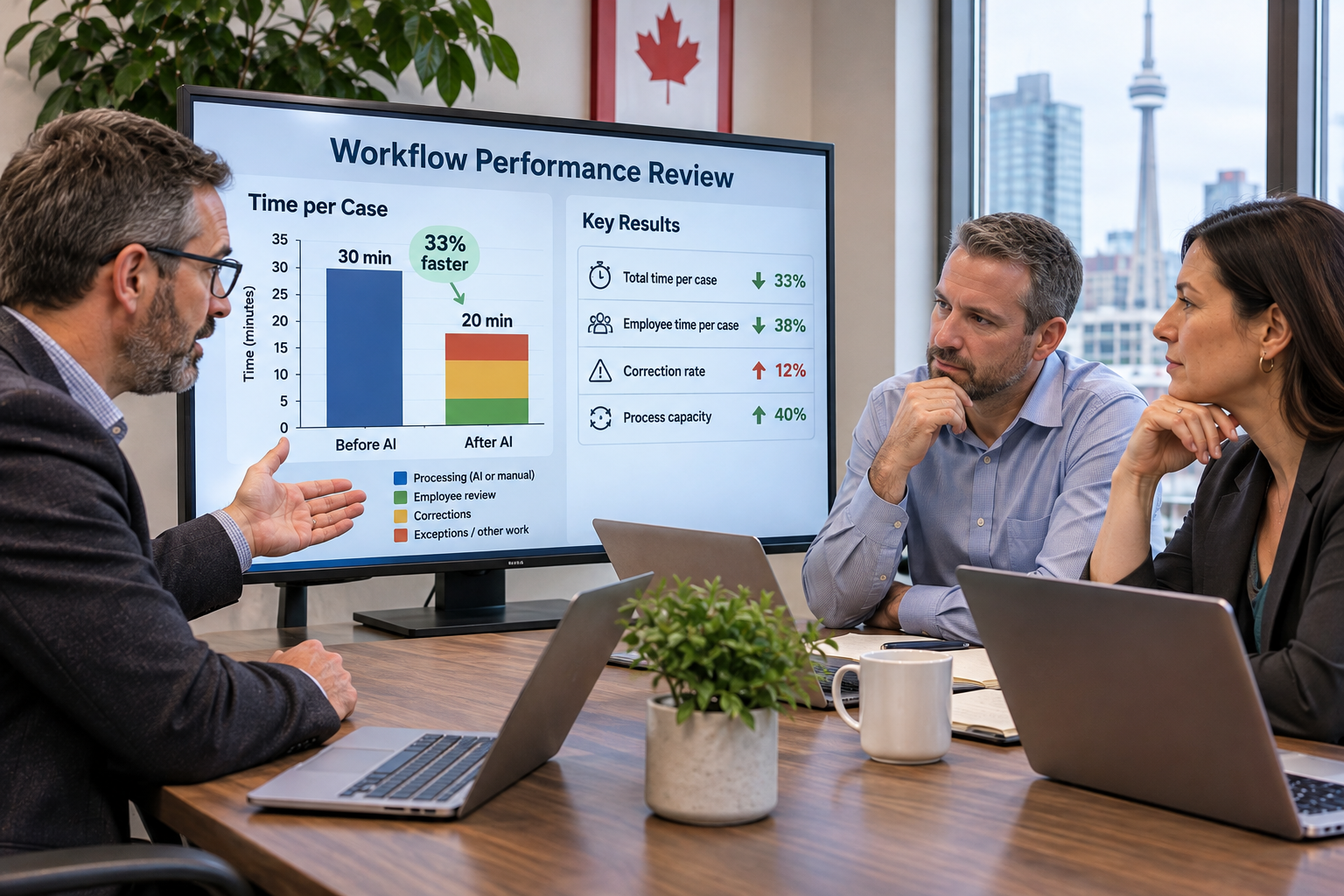
Consider a hypothetical workflow that previously required thirty minutes of employee effort per case.
After AI implementation, the automated task takes two minutes, but employees spend eight minutes reviewing results, seven minutes correcting information, and five minutes handling exceptions.
The new employee workload totals twenty minutes, producing ten minutes of net employee time savings per case.
That is a meaningful improvement, but it differs substantially from claiming twenty-eight minutes were saved because the automated task takes only two minutes.
Businesses must also measure elapsed completion time separately from employee labour.
A process may deliver faster customer turnaround without reducing employee workload by the same amount.
Time savings should not automatically be treated as cash savings unless the business can demonstrate a corresponding financial benefit.
Poor Integration Can Hide the Real Cost of AI
AI may perform its assigned task successfully while surrounding business systems remain disconnected.
Employees may still copy information between applications, reconcile records, check whether updates were completed, correct formatting, or repeat failed transfers.
These activities create additional work outside the AI system itself.
The underlying issue may be system design rather than AI processing capability.
Effective AI system design and integration addresses information handoffs, data consistency, and operational requirements.
Reducing unnecessary manual transfers can help improvements in individual tasks translate into broader workflow efficiency.
Human Review Is Not Automatically Inefficiency
Not every approval or verification activity should be eliminated.
Human oversight may be necessary when decisions involve financial exposure, sensitive information, customer consequences, business judgment, or contractual and regulatory obligations.
Removing these controls solely to improve processing speed may create unacceptable operational exposure.
The objective is to distinguish necessary oversight from repetitive correction work caused by poor implementation.
Operational AI governance helps businesses establish appropriate approval responsibilities, exception procedures, and accountability.
Effective oversight should protect business interests without introducing unnecessary administrative effort.
AI Productivity Needs Ongoing Measurement
Initial implementation results may not reflect long-term operational performance.
Changes in input quality, process volume, employee procedures, business requirements, system integrations, and exception patterns can affect productivity.
An AI system that performs efficiently during initial testing may require additional employee intervention as operating conditions change.
Recurring performance reviews should examine employee effort, correction rates, exception volumes, turnaround times, and relevant business outcomes.
Ongoing AI governance and maintenance supports performance monitoring, recurring error analysis, and adjustments after deployment.
AI productivity should be treated as an ongoing operational measurement rather than a one-time implementation result.
What Should a Business Do When AI Is Not Delivering the Expected Savings?
Disappointing productivity results do not automatically mean a different AI model is required.
The appropriate response depends on where unnecessary work occurs.
Businesses may need to simplify process steps, improve incoming information, eliminate duplicate handling, clarify review responsibilities, or improve integration between systems.
Other situations may require redesigning exception procedures, narrowing the AI system’s responsibilities, or reconsidering whether AI is appropriate for the task.
These decisions should follow an examination of actual workflow performance.
AI implementation consulting in Canada can support process evaluation, controlled improvements, testing, and adjustments based on measured operational results.
The objective is to correct the source of inefficiency rather than introduce additional technology without understanding the problem.
The Best Productivity Metric Is the Business Outcome
A business does not benefit simply because an AI system completes more tasks.
Meaningful productivity improvements may include reduced employee workload, faster turnaround, greater processing capacity, fewer errors, more consistent customer service, or lower operating costs.
The appropriate measure depends on the operational objective established before implementation.
AI productivity ROI should therefore reflect the performance of the complete business process, including the effort required to review, correct, maintain, and support automated activities.
Review your complete workflow before and after AI implementation to identify actual time savings, displaced work, correction costs, and opportunities for operational improvement. Contact Convex to discuss the measurable performance of your existing AI-enabled business processes.