
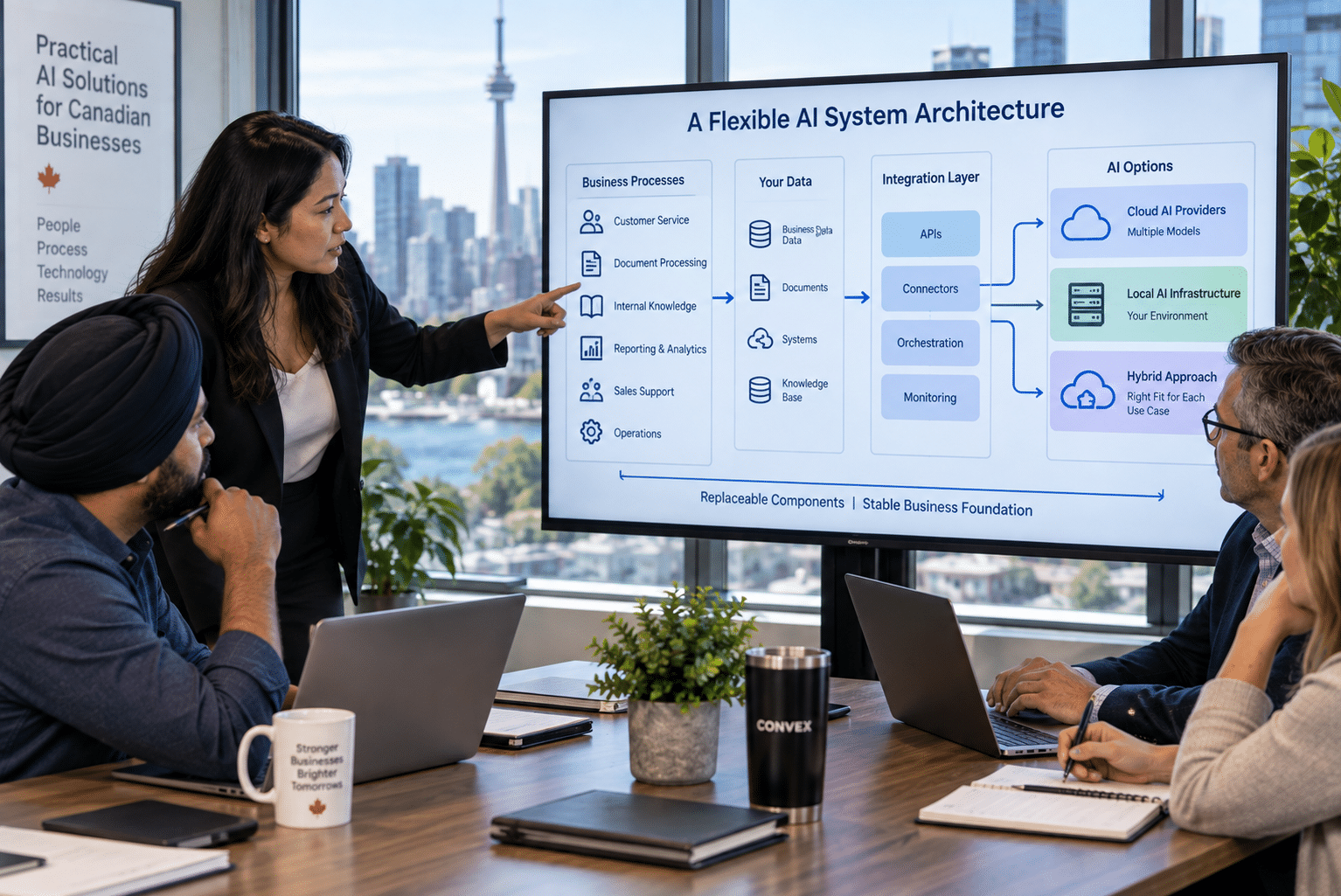
Businesses considering AI implementation face an unusual planning challenge. Models change, providers introduce new services, existing capabilities improve, and costs and infrastructure requirements continue to evolve.
That creates a reasonable question: how do you make a long-term systems decision when the underlying technology keeps changing?
The answer is not to wait indefinitely for the market to settle. It is to separate the parts of the system that require stability from the parts that should be allowed to change.
The Business Process Should Be More Stable Than the AI Model
A business may know what it needs to accomplish even when it cannot know which AI model will be the best fit several years from now.
The organization may need to process incoming documents, retrieve internal knowledge, classify requests, summarize information, prepare reports, route work, support employees, or identify exceptions. Those requirements can remain valuable even if the model performing part of the work changes.
Effective AI strategy consulting should therefore begin with business requirements and acceptable dependencies rather than today’s preferred model or provider.
The starting question is, “What does the business need accomplished?” Not, “Which model do we want to build around?”
Separate the Business Requirement From the AI Capability
Consider a company that receives customer documents and needs specific information moved into an operating system.
The stable process might be: receive the document, identify required information, validate it, route exceptions for review, and update the appropriate business system. AI could perform the information-extraction step without defining the entire workflow.
Good AI system design and integration distinguishes the durable business system from AI components that may change over time.
If another model eventually becomes a better fit, the objective is to evaluate and replace the relevant component without unnecessarily redesigning document intake, approvals, exception handling, or the operating system itself.
Identify What Actually Needs to Remain Stable
Some parts of an AI system have lasting operational value regardless of which model is being used.
Business rules, customer information, company data, approval requirements, process ownership, system records, reporting requirements, governance policies, and exception procedures may all need consistency. These are elements the organization understands and controls.
The AI model itself could be one of the less permanent components.
Before implementation, an AI readiness audit can help determine whether existing processes, information, systems, responsibilities, and ownership are defined well enough to support implementation.
Flexible AI architecture becomes easier when the underlying business process is already understood.
Avoid Building Business Logic Inside One Model or Provider
AI vendor lock-in can emerge when too much of an operational process becomes dependent on one technology.
Provider-specific features, proprietary interfaces, model-specific behaviour, undocumented prompts, platform-specific logic, and employee workarounds can gradually become part of how the business operates. Those dependencies may not be obvious until the organization wants to make a change.
The deeper the dependencies become, the more difficult changing an AI component may be later.
The goal is not perfect portability. Some provider-specific functionality may deliver legitimate business value and be worth using.
The objective is to avoid unnecessary coupling. Changing one AI component should not automatically require rebuilding the entire business process around it.
Replaceable Does Not Mean Interchangeable
A flexible AI architecture does not mean every model can simply be exchanged for another.
Different models may vary in output quality, consistency, speed, context handling, cost, privacy characteristics, infrastructure requirements, and supported capabilities. A process designed around one model’s behaviour may therefore require adjustments when another model is introduced.
Changing models can require evaluation, testing, configuration changes, and sometimes process adjustments.
Good AI system architecture makes replacement manageable. It does not pretend replacement will always be effortless.
That distinction prevents flexibility from becoming an unrealistic technical promise.
Build Evaluation Into the System
If AI components may change, the business needs a practical way to determine whether an alternative actually performs well enough.
Evaluation should connect to business outcomes rather than technology novelty. Depending on the use case, useful measures might include accuracy, exception rates, employee review time, processing time, consistency, operating cost, or customer impact.
For example, a newer model may produce impressive results in general testing but increase the number of exceptions employees need to review in a particular business process. In that case, newer does not necessarily mean better for that workload.
Without defined criteria, organizations can chase new technology without knowing whether it improves anything that matters operationally.
Evaluation gives leadership a more useful question to ask: does this change make the system perform better for our requirements?
Cloud, Local, and Hybrid Are Architecture Decisions
Some AI capabilities may work best through cloud providers. Others may justify locally operated infrastructure. Different workloads can have different requirements, and those requirements can change over time.
An AI infrastructure strategy does not necessarily need to make one permanent decision about where every capability must operate.
Hybrid AI systems consulting can help businesses consider how cloud services, local capability, and different providers fit into a broader architecture without forcing the entire system onto one path.
This can preserve appropriate infrastructure and model options where flexibility has business value.
The objective is not maximum flexibility at any cost. It is avoiding unnecessary restrictions on future choices.
Do Not Build Redundancy Everywhere
Flexibility can become expensive and difficult to maintain when applied without regard for business importance.
Not every AI function needs multiple providers, local backup infrastructure, duplicate systems, elaborate failover, or continuous evaluation of competing models. Every additional option can introduce testing, maintenance, documentation, and governance requirements.
A minor internal productivity tool deserves a different architecture from an AI capability embedded inside an important customer or operational process.
The amount of flexibility should reflect the consequences of change, switching difficulty, importance of continuity, and cost of maintaining alternatives.
Once those decisions have been made, AI implementation consulting can translate the adaptable architecture into practical deployment, integrations, workflows, and operating procedures.
Governance Needs to Include Technology Change
AI governance is not only about determining what AI is permitted to do. It should also establish how the organization manages changes to the technology itself.
Someone needs responsibility for decisions such as changing models or providers. The organization should know what must be tested, what performance is acceptable, what needs to be documented, when employees require retraining, and how changes will be monitored after deployment.
Operational AI governance can establish accountability for evaluation, change control, approvals, and ongoing monitoring.
The purpose is controlled adaptation rather than resistance to change.
When responsibilities are clear, the business can evaluate new options without treating every technical development as either an urgent migration opportunity or something to ignore.
Maintenance Becomes Part of AI System Design
An AI system should not be designed only for launch day.
Businesses should consider what happens when a better option becomes available. They should also consider what happens when an existing component is no longer the best fit for the workload.
A maintainable system provides a defined process for assessing those changes. Documentation, testing procedures, evaluation criteria, ownership, and change records can reduce the need for rushed redesign later.
Ongoing AI governance and maintenance can support continued testing, documentation, system updates, and adaptation after implementation.
Maintenance therefore becomes part of the architecture rather than an issue considered only after deployment.
“Future-Proof” Should Not Mean Predicting the Future
No business needs to correctly predict which model, provider, hardware platform, or AI capability will be the best choice several years from now.
Trying to make those predictions the foundation of an AI implementation strategy creates a standard that good systems planning does not require.
A more useful definition of a future-proof AI system is one where reasonable change remains possible.
That does not require endless redundancy or constant rebuilding. It requires knowing which components should remain stable, which can change, where dependencies exist, and what process will be used to evaluate potential changes.
Build Around What Your Business Knows
AI technology may change quickly, but businesses often have much more stable knowledge about their customers, processes, information, responsibilities, operating requirements, risk tolerance, and desired outcomes.
Those elements should form the foundation of AI systems design.
Models, providers, and infrastructure can then serve those requirements rather than defining them. When technology changes, the business can evaluate the new option against requirements it already understands.
The result is not an AI system designed around one moment in technology. It is a business system designed to evolve.
Design AI around stable business requirements while keeping models, providers, and infrastructure appropriately replaceable as the technology evolves. Contact Convex Systems to discuss an AI system architecture designed around your business requirements and appropriate options for change.