
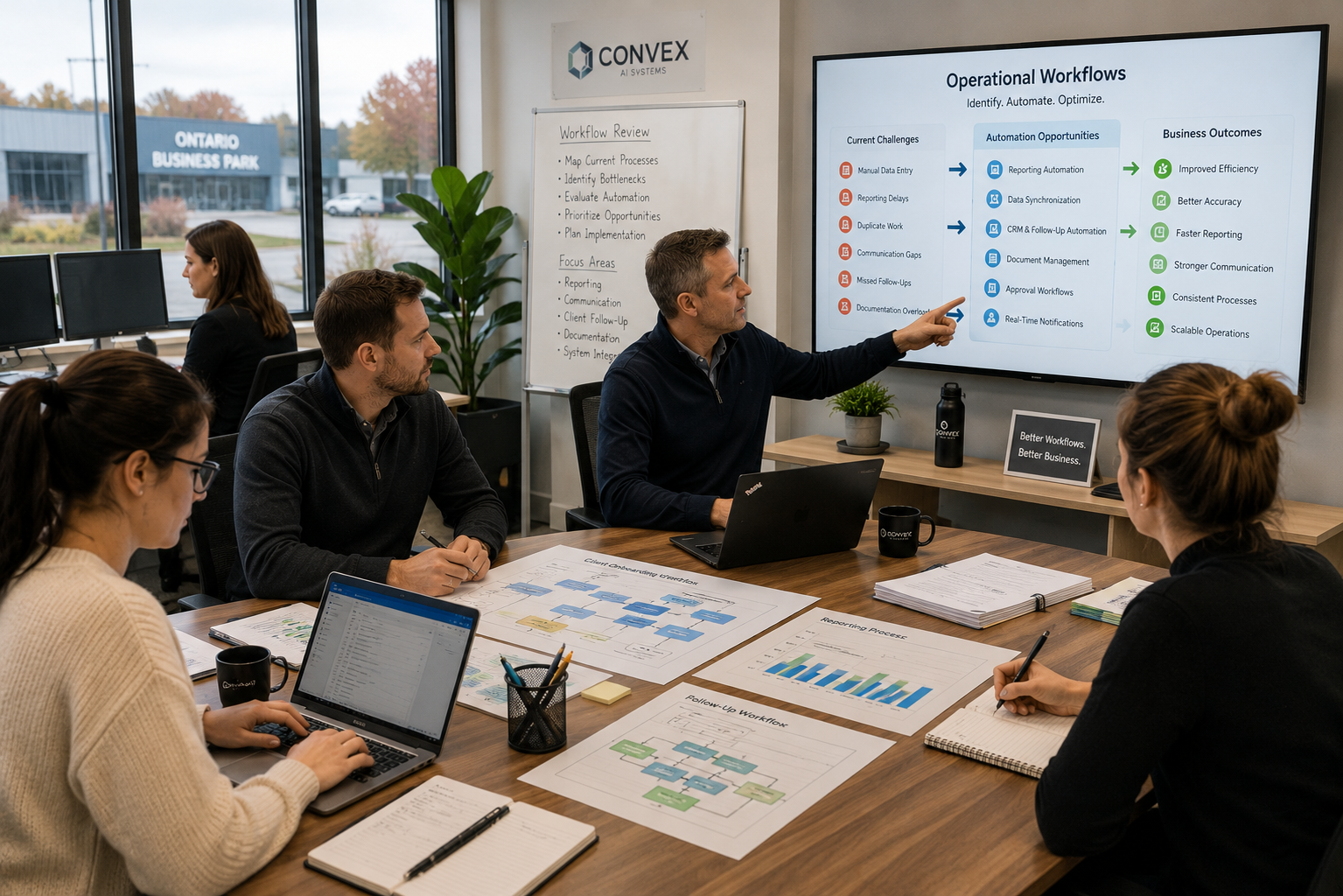
As businesses grow, operational demands often increase faster than existing systems can handle. Reporting requirements expand, customer communications multiply, and administrative processes become more complex. In many cases, the first response is to hire additional administrative staff. While this can provide short-term relief, it does not always address the operational issues creating the workload in the first place.
Businesses with mature operational systems often evaluate whether process improvements should come before headcount expansion. This is a core objective of Business Systems Consulting, which focuses on understanding how work moves through an organization before recommending staffing or technology changes.
Why Hiring More Admin Staff Often Fails to Solve Operational Bottlenecks
Administrative hiring is frequently used to manage growing workloads. However, if the underlying workflows remain inefficient, additional staff may simply absorb operational friction rather than eliminate it.
For example, businesses often add personnel to manage reporting requests, data entry, customer follow-ups, or documentation tasks. Over time, the workload continues to increase because the process itself remains unchanged.
When operational bottlenecks are caused by duplicate data entry, disconnected systems, inconsistent procedures, or manual handoffs, hiring more people may increase capacity without improving workflow efficiency.
This is why many organizations begin evaluating automation opportunities through structured operational reviews and AI Strategy Consulting. The goal is to determine whether the problem is truly a staffing shortage or a workflow design issue.
The Types of Operational Work That Scale Poorly
Certain administrative functions become increasingly difficult to manage as organizations grow.
Manual reporting is a common example. Teams may spend hours collecting information from multiple sources before creating reports. Processes such as a Reporting Workflow often become more time-consuming as business activity increases.
Communication management can also become a significant challenge. As organizations expand, internal requests, approvals, and information sharing create delays within the Communication Workflow.
Documentation responsibilities frequently grow as well. Maintaining consistency across procedures, records, and operational knowledge becomes more difficult without a structured Documentation Workflow.
Other operational activities that commonly scale poorly include:
- Data entry across multiple systems
- Client follow-up activities
- Appointment scheduling and coordination
- Documentation management
- CRM updates and record maintenance
Customer relationship management is a common example. Many businesses manually transfer information between systems when opportunities may exist for solutions such as a CRM OpenAI Integration.
In each case, administrative effort increases because the process itself requires repetitive human intervention.
What Workflow Automation Actually Solves
Workflow automation is often misunderstood as a staffing alternative. In reality, its purpose is to improve process consistency and reduce unnecessary administrative effort.
A structured AI Workflow Automation initiative focuses on improving how work moves through the organization. This may involve reducing manual handoffs, improving communication flow, standardizing documentation, or streamlining routine operational tasks.
For example, repetitive follow-up activities within a Sales Follow-Up Workflow may be standardized through workflow design improvements rather than relying entirely on manual administration.
Organizations often experience operational improvements through:
- Better process consistency
- Reduced administrative duplication
- More reliable reporting
- Improved communication flow
- Stronger documentation standards
- Better visibility into operational performance
The objective is not to replace employees. The objective is to create operational systems that allow teams to focus on work requiring judgment, problem-solving, customer interaction, and decision-making.
The Warning Signs That a Workflow Should Be Automated
Several indicators suggest that workflow redesign or automation may be worth evaluating.
Employees repeatedly copying information between systems is one of the most common warning signs. Reporting delays, missed follow-ups, duplicate administrative work, and documentation inconsistencies are also frequent indicators.
Other warning signs include:
- Multiple people performing the same administrative task
- Approval bottlenecks that delay work
- Frequent communication breakdowns
- Repetitive customer communications
- Lack of visibility into process ownership
- Manual synchronization between software platforms
Businesses frequently discover these issues when reviewing operational system connections and processes such as Workflow Sync Maintenance.
Organizations experiencing these challenges often benefit from a structured evaluation process such as an AI Readiness Audit, which helps identify whether operational bottlenecks are process-related, system-related, or staffing-related.
When Hiring Still Makes More Sense Than Automation
Automation is not always the correct solution.
Some business activities require human judgment, relationship management, creativity, or specialized expertise. In these situations, additional staffing may be more appropriate than workflow automation.
Hiring often makes more sense when:
- Processes are still evolving
- Work volumes fluctuate significantly
- Customer interactions require nuanced decision-making
- Service delivery depends on professional expertise
- Operational procedures have not yet been defined
This distinction is important because automation works best when processes are repeatable and predictable. If the workflow itself remains unclear, automation can introduce additional complexity.
A balanced operational assessment should always consider both staffing and automation options before recommending a path forward.
Why SMBs Need Workflow Structure Before Scaling Operations
Successful automation depends on operational maturity.
Businesses should establish clear workflow ownership, documentation standards, accountability structures, and process visibility before pursuing large-scale automation initiatives.
This becomes particularly important in industries experiencing growth-related administrative pressure, including Manufacturing and Logistics and Construction and Trades.
Without defined ownership and consistent procedures, automation initiatives often struggle to deliver sustainable operational improvements.
Strong operational systems create the foundation for long-term scalability.
How Businesses Can Evaluate Automation Opportunities Properly
The most effective approach begins with understanding how work currently moves through the organization.
A structured evaluation process typically includes:
- Workflow mapping
- Bottleneck identification
- Process analysis
- System reviews
- Integration planning
- Automation feasibility assessment
Following the assessment, organizations may move into implementation planning through AI Implementation Consulting Canada and supporting initiatives such as AI System Design & Integration.
Long-term success also requires accountability and oversight. Operational frameworks supported through Operational AI Governance and ongoing Governance & Maintenance help ensure workflows remain aligned with business objectives as operations evolve.
Automation should be viewed as a structured business decision rather than a technology purchase. Organizations that evaluate operational systems first are typically better positioned to identify practical automation opportunities and scale more effectively.
Businesses interested in broader operational improvement initiatives can explore additional Solutions designed to support workflow optimization, system integration, and operational maturity.
Book a workflow assessment to identify repetitive operational tasks that can be automated before expanding administrative headcount. To start the conversation, visit the Contact Page.