
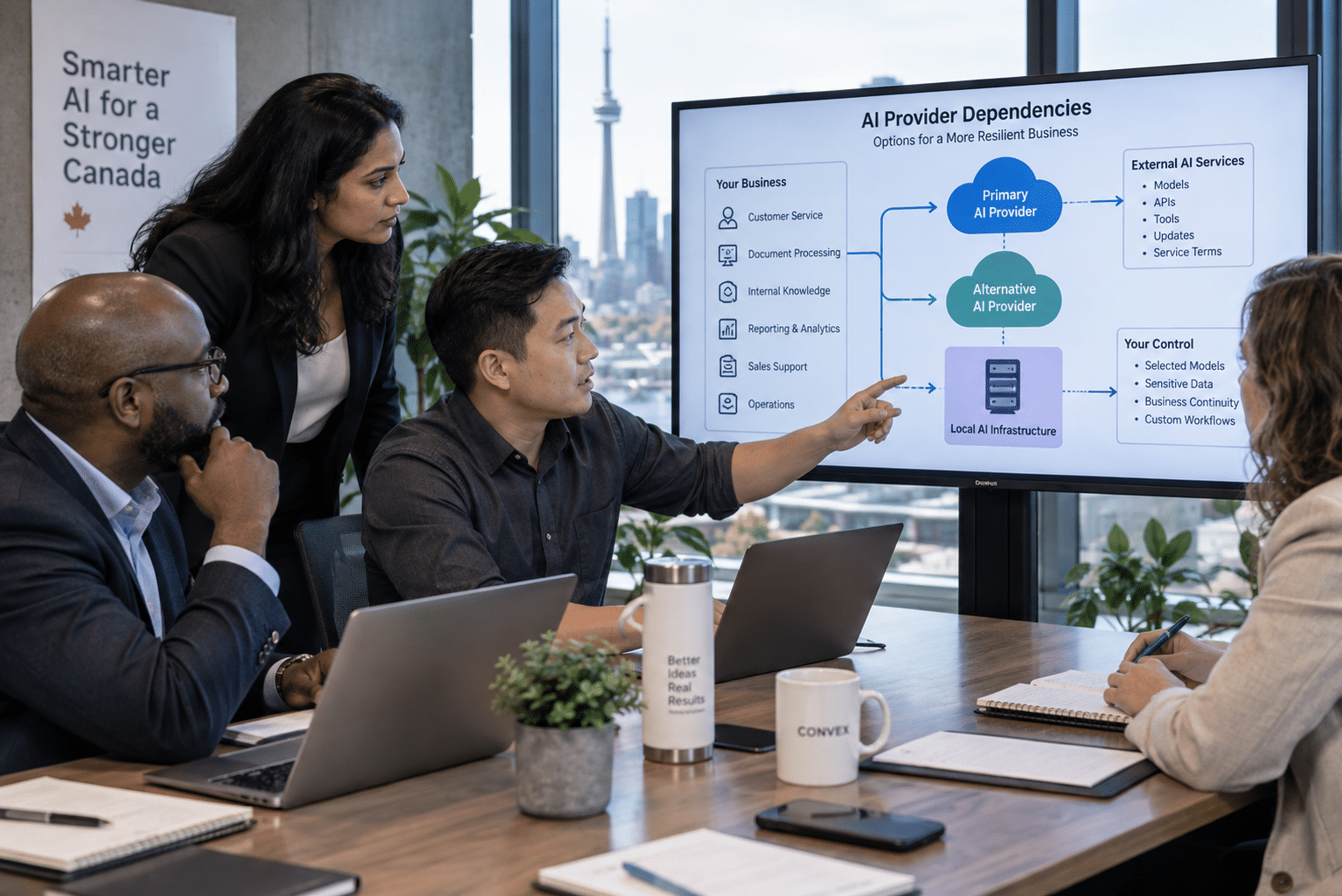
AI is becoming part of normal business infrastructure. Companies are increasingly using external AI capabilities for customer service, document processing, research, reporting, internal knowledge, sales support, administrative work, and decision support.
As these systems become operationally useful, another question becomes important: what does the business depend on for those systems to continue working?
The more important an AI-supported workflow becomes, the more important it is to understand that dependency. This is where AI vendor lock-in becomes a business consideration rather than simply a technical concern.
Using an AI Provider Creates a Business Dependency
Depending on an external provider is not inherently a problem. Businesses already rely on cloud hosting, accounting software, payment processors, CRM platforms, telecommunications companies, and email providers.
AI introduces another dependency to manage.
The issue is not simply that an external AI provider exists. It is whether the business understands how much of its operations depend on that provider and what would happen if the conditions surrounding the service changed.
Acceptable AI provider dependency should be considered during AI strategy consulting, before important business processes become deeply embedded around a particular platform.
“Changing the Rules” Can Mean Many Things
A provider change does not have to involve a dramatic shutdown or complete loss of access. Normal commercial and technical changes can still affect systems built around a particular service.
Changes could involve pricing structures, model retirement, APIs, usage limits, features, licensing terms, data-handling practices, regional availability, account requirements, or model behaviour. A provider could also replace one model with another as its services evolve.
Some changes may have little operational effect. Others could require additional testing, budgeting, system changes, employee training, or migration.
The business therefore needs to understand which changes matter to its operations rather than reacting equally to every provider announcement.
The Important Question Is What Breaks Downstream
Provider changes matter primarily because of what they could affect inside the business.
If a model, API, feature, or service changes, what happens downstream? Does it affect a customer-facing process? Does document handling still work correctly? Do internal reports produce the expected results? Can employees continue following established workflows?
Integrations, automated decisions, response quality, processing times, and operating costs may also be affected depending on how the system has been designed.
This is where AI vendor risk becomes an operational issue. The important exposure is not the provider announcement itself. It is the downstream business dependency created around that provider.
Not Every AI Dependency Deserves the Same Protection
Businesses should not treat every use of AI as equally important.
An optional tool that employees occasionally use for brainstorming has very different continuity requirements from an AI model embedded inside a customer-facing or operational process.
Dependencies can be classified according to business importance, frequency of use, information sensitivity, availability requirements, switching difficulty, financial consequences, customer impact, and availability of alternatives.
A low-impact system may only require basic documentation and periodic review. A system that supports an important daily process may justify stronger continuity planning and a clearer understanding of alternative options.
This proportional approach keeps AI business continuity practical. The objective is not to build expensive redundancy around every AI tool. It is to give important dependencies an appropriate level of attention.
The Hidden Risk Is Often Deep Integration, Not Provider Choice
An organization may assume that changing AI providers will be straightforward because competing models or services are available. A technical alternative, however, does not necessarily make an existing system operationally portable.
Over time, systems can accumulate provider-specific prompts, model behaviours, proprietary features, APIs, authentication methods, data structures, workflow logic, evaluation criteria, and employee procedures.
This creates an important distinction between being technically replaceable and operationally replaceable.
Another provider may offer a suitable model, while actually making the switch still requires substantial redesign and testing. Effective AI system design and integration should account for these dependencies as part of the overall architecture.
Portability Needs to Be Designed Before It Is Needed
Businesses do not need to eliminate every provider-specific dependency. They do need to understand where those dependencies exist and how difficult they would be to change.
System planning can identify which information belongs to the business, how integrations are structured, whether models can reasonably be substituted, and how alternatives would be evaluated. Documentation can establish what provider-specific assumptions exist and how important business processes should continue during changes.
Portability also requires thinking beyond the model itself. Data structures, application logic, authentication, monitoring, employee procedures, and quality standards may all influence how difficult a migration becomes.
Provider flexibility then needs to move from planning into the actual system. AI implementation consulting can help translate decisions about portability, integrations, and operational requirements into working infrastructure.
The goal is not zero dependency. It is understood and manageable dependency.
Should Every Business Maintain a Backup AI Provider?
Not necessarily.
Redundancy creates costs of its own. Maintaining multiple providers can introduce additional integrations, testing requirements, maintenance work, employee knowledge requirements, and governance responsibilities.
There is also little benefit in maintaining an alternative that has never been tested. A backup provider may be technically available while still requiring substantial operational work before it can support an existing process.
A low-impact AI use case may not justify those costs. A critical operational process with difficult switching requirements may deserve a different level of preparation.
The decision should follow the business consequences of disruption or change rather than generalized concerns about AI providers.
Local AI Is Another Option, Not a Universal Backup Plan
Local AI capability can potentially reduce external provider dependency for selected workloads. It can give a business more direct control over where certain models operate and how particular processes are maintained.
However, local infrastructure creates its own dependencies and responsibilities. Hardware, maintenance, model management, security, compatibility, software updates, and internal expertise all become part of the operating model.
Local AI should therefore be treated as another architectural option rather than an emergency escape route from cloud providers.
The relevant question is whether local capability solves a specific business requirement well enough to justify the additional responsibility.
Hybrid Systems Can Reduce All-or-Nothing Decisions
A business may eventually determine that different AI workloads deserve different infrastructure decisions.
Some workloads may remain with a primary cloud provider. Others may be designed so they can move between providers. Certain private or continuity-sensitive workloads might justify local capability, while minor use cases may not require redundancy at all.
Hybrid AI systems consulting provides a way to consider those requirements individually rather than forcing every AI workload into the same architecture.
This approach does not eliminate AI provider dependency. Instead, it allows businesses to decide deliberately where provider dependency is acceptable and where greater flexibility has enough operational value to justify the additional design work.
The purpose is not independence for its own sake. It is maintaining appropriate operational flexibility.
Governance Includes Watching What Your Providers Change
AI provider dependency also needs attention after deployment.
Someone should have responsibility for monitoring relevant changes involving models, pricing, terms, APIs, security, performance, data handling, and system compatibility. Operational AI governance can establish who owns those responsibilities and how potentially significant changes are assessed.
The next step is determining whether a change actually matters. A new model release may have no effect on an existing process, while a smaller technical change could require testing because of how deeply a particular service has been integrated.
Ongoing AI governance and maintenance can address model updates, system changes, testing, documentation, and continued operational suitability as the technology evolves.
The useful question is not, “What changed in AI today?” It is, “Does this change affect our business?”
Build for Change Without Trying to Predict It
Businesses do not need to know which AI provider will lead five years from now. They also do not need certainty about future models, pricing, regulations, or infrastructure.
They need to know where they are dependent, how important each dependency is, how difficult changing it would be, and which dependencies justify alternative options.
That turns AI vendor lock-in from an abstract concern into something leadership can evaluate and manage. It also allows organizations to benefit from external AI providers without assuming today’s commercial and technical conditions will remain unchanged indefinitely.
Review where your business depends on individual AI providers and determine whether critical systems need greater portability, alternative providers, local capability, or a hybrid architecture. Contact Convex Systems to discuss the dependencies and continuity requirements within your AI systems.